Meaningful Matters

I used to want to change the world, now I just want the world to change. The difference is significant, I think – less pressure on me, for one thing! But more that there are so many people who want the same thing. When it comes to the way we care for older adults, I believe the change has already begun, thanks to companies like Meaningful Care Matters where I work as Associate Consultant. I also believe that the concepts we are teaching can be applied on a broader spectrum, especially in leadership.

At Meaningful Care Matters, we have a team of consultants who teach the Butterfly Approach™ to person-centred care in care settings (i.e. long-term care homes) around the world. A favourite (read: cheeky) way I describe what I do is simply that I teach people to be nice to other people. In reality, it’s actually more that we teach already nice people transformative ways to care for each individual (generally older adults, but not always) who lives in their care home.

It almost sounds too fundamental and basic. How do you treat someone as an “individual” that could be any different than has always been done? Henry is Henry, a long-term care resident with a detailed plan of care that will tell you his diagnosis and course of treatment, as per regulatory requirements. Maria is Maria, a team member who was recently recognized as employee of the year, they even gave her flowers and a lovely hand-written note. How are Henry and Maria not being treated as individuals?

The answer can be found in the concept of “Meaningful Engagement”, one of the five types of care taught in the Butterfly Approach™. Meaningful Engagement is a type of Positive Care (positive = being kind and compassionate, providing choice, etc.) with the added element of connecting on a human level through the knowledge of a person’s life story, appropriate physical touch, facilitation of independent occupation, etc. Basically, connecting with the human being and making them feel valued and important.

In other words, Positive Care would be knowing and using Henry’s name. Meaningful Engagement is knowing Henry was named after his father who died in the war and never got to meet his only son. Really good Meaningful Engagement is knowing that Henry was raised by his mother and two older sisters and had to drop out of school at grade eight to help put food on the table so he might get a little belligerent in a care home setting if he doesn’t have something to occupy him, something that gives Henry a sense of purpose.

In leadership, Positive Care would be knowing that Maria has been a nurse for 20 years and loves helping people so much that she won employee of the year last year. Meaningful Engagement is knowing that, at the end of every shift, she goes home to take care of her own mother, who is a widow and has been fighting cancer. Really good Meaningful Engagement is helping Maria adjust her work schedule to accommodate the many doctors appointments she would like to attend with her mom, because Maria can’t miss work and also pay the mortgage.

For the past six months, I have had the uncommon and fortunate privilege of going into long-term care homes across the province to teach and/or audit teams working toward Meaningful Care Matters Accreditation. I’m still new in this work and have a lot to learn, but it seems to me that the teams who have the easiest time learning the Butterfly Approach™ have leaders who approach them the same way, as individuals with value and purpose. Having been in the workforce for enough years that I’m shocked to count, I can confidently say that I have the uncommon and fortunate privilege of having leaders who treat me as an individual with value and purpose. The difference is Meaningful Engagement. And it matters.
Feelings, nothing more than feelings


I ran into Jane in the hall today. As I was saying hello she told me she wanted to talk, so we sat down together in my office.

Jane has lived with us for just over a year. She is in her early 90s and is one of those women who is beautiful inside and out. She was married for 65 years, raised three children who now have grandchildren of their own.

Jane has dementia. You probably know by now that I find working for people living with dementia fascinating, and Jane is unique in that most people can’t really tell there is anything wrong. She can hold short social conversations, she is kind and welcoming to everyone around her. But her short-term memory has an expiry of mere moments, and that makes her very anxious.

Settling into conversation in my office, Jane was distraught when she told me that she couldn’t “remember anything” and she didn’t know what to do. We have had this conversation a dozen times or more since we met. Jane doesn’t remember, but I do, and I have delicately tested how to respond over time, so today I simply said “I know.”

“Why is this happening?” she asked. And, while dementia is NOT a normal part of aging, it is for Jane, so I responded “because you are getting older and your brain is, too.” I explained how, like her skin is drying and wrinkling, her brain is drying and wrinkling a little, too, making the signals harder to get where they need to be. (There is very little science in this, mind you, just a simplistic way of explaining what is happening.)

“What can I do to make it stop?” was her response.

“Nothing, Jane. And it’s okay. Your life is different now but it is still good. You are a beautiful, kind woman. You have a smile that lights up the room and people feel good when they are around you. That’s all you need to know.”

“Really?” she said with a sigh of relief, assured in the moment.

A few moments later she told me that she was really confused and asked why. I calmly repeated what I had said before as if it was new information (because, to Jane, it was new information).

“But what can I do?” she cried.

“Just keep living your life. Keep putting one foot in front of the other. You are doing okay. You get confused, but most of the things we do every day are instinctual and habitual. There is a whole team of caregivers here to help you, so there are a lot of things you don’t even need to remember. Just live your life and do things that make you smile, we will make sure you are okay and everything will be just fine.”

Please recognize that I believe in individualized care and wouldn’t generally approach someone I didn’t know as I now approach Jane. Although she has no recollection of ever being in my office, the fact is she has sat in the same chair and said the same words many times. I’ve learned from getting to know her and her family that the best thing I can do is calm her anxieties by allowing them to be expressed. I can hold her hand and let her tell me she doesn’t understand over and over until I help her accept, once again, that she is okay.

Maya Angelou told us that people might not remember what we say and do but they’ll remember how we made them feel. People like Jane don’t *remember* how we made them feel. But they still feel it. And, to me, that’s the most important part of all.

A Penny for my thoughts

Go forward with smiles and enthusiasm, my love. Live life in your own truth and fight for your happiness, but please understand something very important: life is not short.

“The days are long but the years are short” is a favourite quote of mine that explains it is in retrospect that life seems short, but it can feel like it’s taking forever when you’re trying to make significant changes. Give yourself permission to fall, to hurt, to do things wrong sometimes. Because then you get to do better and better.

If you’re lucky, and I truly hope that you are, you will live a long and happy life. You have time to try, and time to try try again. You are evolving; it happens in spurts, fast and slow. Forgive when you fall and keep getting up. Rest, but don’t stop. When you recognize there is no such thing as perfection, you will understand there is always room to grow.

Now go. Grow. I love you 💗

Put yourself in this wheelchair

Imagine this: You’re 60 years old. You buy a new pair of shoes and develop a blister on your foot. Of course, that has happened many times over the years but this time it doesn’t seem to want to heal. And because that blister won’t heal it gets worse, and your skin starts to break down around it, and your flesh and bones deteriorate beneath. Some time later you’ll find out that it’s because your blood isn’t circulating properly; right now, though, you just feel like your body is failing somehow and you don’t know why and you can’t make it stop. It gets so bad that eventually they have to take your leg off below the knee to save your life. And the following year, it happens to your other leg.

Now you’re 67. You have no legs. Your husband died a year ago and you live in a retirement residence because, although you are perfectly strong and independent mentally, you can’t physically live alone.

On a hot summers day you take a nap in the late afternoon, and wake up a little chilled by the air conditioner next to you. You want to go out to get some fresh air and be warmed by the sun so you press your pendant to request assistance out of bed. No one comes. For more than an hour, no one comes. The bell is wired to ring a reminder every few minutes until it is reset. So, for more than an hour, you have to sit there, listening. Buzz buzz buzz, no one comes, no one comes.

You sit in your bed hating everything. Hating. Everything. You can’t go to the bathroom by yourself, you can’t walk over to the shelf and pick up a book, if you drop the remote control you can’t retrieve it, you can’t even get out of your own damn bed until someone comes to help you. Still, no one comes.

The buzzing and vulnerability and frustration rise within you so much that by the time someone finally does show up, everything you’ve been thinking for all of that time comes out of your mouth in a rush of anger. You just can’t keep it inside anymore. But wait, there’s more. Because you need a mechanical lift it takes two people to help you out of bed. But two out of three people didn’t show up for their job tonight, which is why no one answered your call sooner. Which means you still can’t get out of bed.

You are at the end of your rope so you yell, and the person who actually did show up has to go get the manager because you’re “misbehaving”, which makes the anger even worse. By the time the manager comes in, you feel like you would rather throw yourself onto the floor and suffer the consequences than spend another damn minute in that damn bed…

Anyway, that’s what happened when you didn’t show up for work today. Try a little harder tomorrow, please.

**Posted with permission from the subject**

Lessons in dementia, and humanity

When I answered the knock on my office door yesterday morning, I was surprised to see Bill and Thi-Tam on the other side. Bill has been going into most of our third floor suites every day since he moved in last week, including Thi-Tam’s, because he is looking for help. Thi-Tam, a sweet Vietnamese lady who speaks very little English, brought him to me, I’m sure with the hope that I could help them both.

Bill has dementia. Not just getting confused and forgetting things from time to time, he almost resets within moments, so that anything you tell him or do for him is gone from his memory very quickly. He is a kind soul who must now look at the world as a very scary place.

Like I said, Bill was looking for help. He needed someone to help him get home because he didn’t know where he was and, what was even more upsetting, he couldn’t remember his address or how to get there. I asked Bill to sit with me for a minute and explained that he is living with us right now. I told him that his daughter had to go away for a little while and she asked if he could stay in our hotel so she could be sure that he ate well and had someone looking out for him when he feels confused like now. I pointed to my mask and explained that ordinarily his neighbours would come help out because they really care about him, but because of the pandemic people aren’t supposed to go into each other’s houses. And I told him we care about him too and are happy to to share our home with him. (Through interactions with me and other members of our team, I knew his arguments and could be proactive in my explanations.)

As Bill and I walked back to his room, he returned to asking why he couldn’t just go home so I hesitantly explained that sometimes his memory played tricks on him. He asked what I meant so I told him that only a few moments before he had told me he didn’t remember his address – then he stood tall and recited it completely, as if to prove me wrong. (What he actually proved was that the information is still in there, but having dementia means he isn’t able to access it very well anymore.) Again I explained the hotel scenario as I settled Bill back into his chair by the window. It only took a moment before he smiled and told me about all of the accidents and excitement that has been happening in our parking lot below. He told me it had been even worse months ago when there was snow on the ground. I tidied his room and poured him a glass of water as he thanked me for helping him and asked over and over if I would come back and visit. I promised that I would.

When the power went out later in the day, I was checking on the wellbeing of our residents on the third floor and found Bill walking toward Thi-Tam’s room again. I said something like “oops, sorry Bill, I think you have the wrong door” and led him back to his room, pointing at his name on the door sign. We went inside and he told me he had a real problem and needed my help. He told me that a man had come into his room and Bill had offered him money to help him get home, the man took $200 and left. Now Bill was upset that he couldn’t get home and the man had his money. I knew that Bill only had $40 in his wallet (he offered it to me to often during the first few days!), so I asked Bill to describe the man. At first he couldn’t remember but then said he was a little bit shorter than him, with a shirt similar to his and blue jeans like the ones he was wearing. “Of course,” I told Bill, “I know just who you’re talking about.” I said I was pretty sure that the man was downstairs looking for a ride for him and that Bill should stay in his room so the man could be sure to find him when it all got worked out. I had to get back to the power outage situation so I told Bill that I would go see what was taking the man so long, and he gladly let me go.

This is how things have gone over the week that he has been with us: Bill’s anxiety causing him to constantly seek reassurance and comfort; his family struggling with guilt and grief, and most likely a little relief, that they had to accept help when they weren’t able to overpower this awful disease; our residents torn between not wanting a stranger to invade their private space and wanting to help a man in distress; our staff struggling to care for someone who needs a different kind of care than they are used to; and me trying to determine the best course of action while seeking ways to learn and do better next time.

Even though our nurse was as proactive as possible by doing Bill’s initial intake assessment during the time that sundowning (a neurological phenomenon that affects more than half of people living with dementia) is most likely to occur, having a lovely stranger visit his home put him on his best behaviour. As I mentioned above, his challenges go beyond simple forgetfulness but his instinctual self is still in there. There was no way to know for sure before he came, but it is obvious now that our residence isn’t the best place for him; his care needs are more acute than we are able to manage properly. But where do we go from here? Sending him home again would just put the family’s distress back to square one, or worse if this experience caused them to stop asking for help. Bill needs continuous attention, but the list for long term care is several years long. We were advised that we could send him to the hospital so he could go on a crisis list to get into long term care faster, but the upheaval would only increase his anxiety. And if he goes into care they would most likely medically sedate him, when all he wants is comfort and all he really needs is calm.

Being relatively new to the area, I started asking around to see if there were any private memory care communities locally and was surprised to learn that most people didn’t even know what I was referring to, they had only heard of that type of care in a long term care facility. Eventually I learned that our sister community a couple of towns away offers memory care so I called to find out pricing and availability, and then called Bill’s daughter to explain the situation and offer the best solution I could find.

Bill leaves on Monday and, I have to say, I’m going to miss him. In only a week he has already taught me so much. Having recently studied about dementia, the time I spent with Bill really gave those lessons substance. I keep thinking about that much quoted theory that people don’t always remember what you did but they’ll always remember how you made them feel. I think that people who live with dementia might not remember how you made them feel, but the important part is that they will feel it. If you continuously approach with calm, they will feel calm. If you meet them where they are and suggest explanations for the things they don’t understand, they will feel calm. If you practise patience and therapeutic reasoning when they ask the same questions over and over; if, instead of arguing and telling them they are wrong, you go along with their narrative and provide comfort, they will feel calm. And with calm Bill will be able to have conversations and tell stories and laugh again, and he will be okay. He will be different, because his brain doesn’t work as it once did, but he will be okay. And that will have to be okay.

**Published with permission from Bill’s family**

Complaint

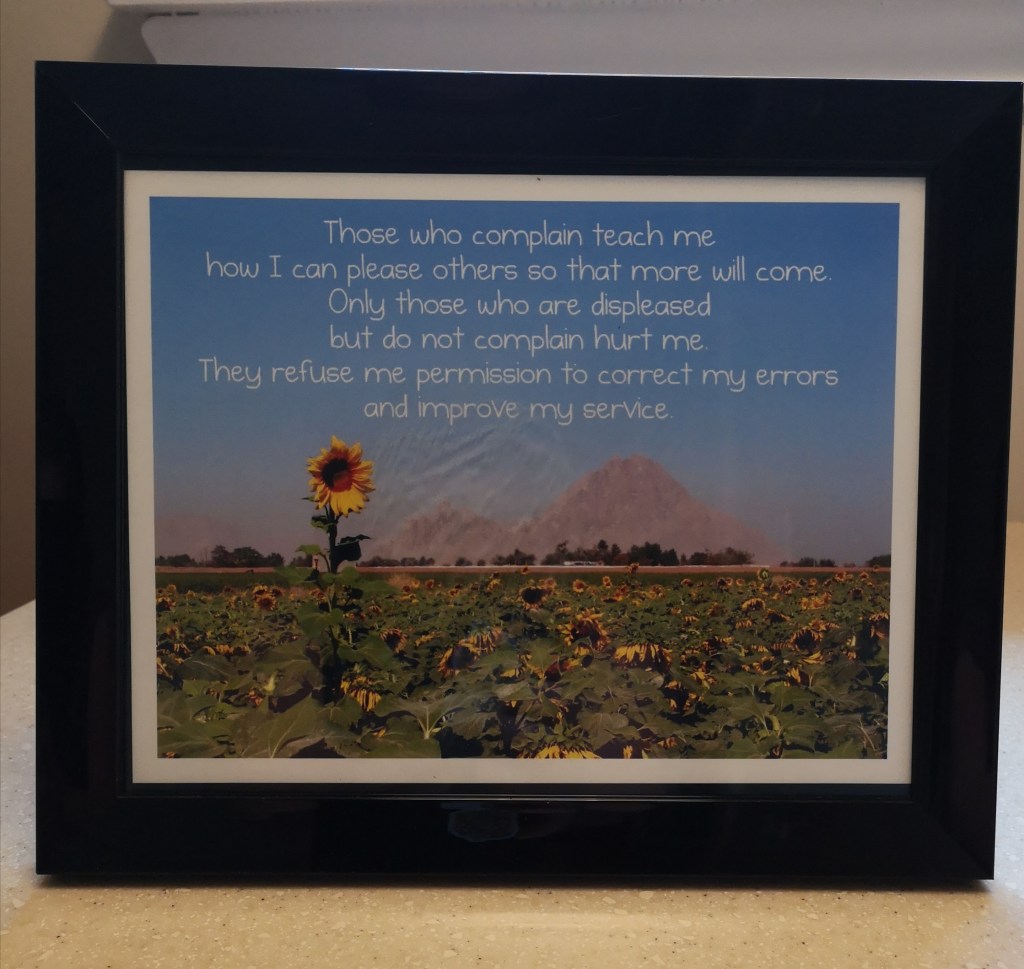
In 2008, when I was planning my future, I imagined what it would look like. I had no idea what was coming in my personal life but I knew what I wanted from my professional life. One day when I was particularly ambitious, I made this to go on the wall of my office. It says “Those who complain teach me how I can please others so that more will come. Only those who are displeased but do not complain hurt me, they refuse me permission to correct my errors and improve my service.” It has moved with me countless times over the years, but I refused to hang it until I was the person responsible for handling complaints.

Today one of our residents came into my office. She was frustrated, I could tell. In fact, I’d mentioned to our nurse earlier that she’d seemed a bit off these past few days. I haven’t known her long, but something was wrong.

I listened as she told me she didn’t like the pandemic restrictions I was putting in place, how she was mad about something another resident had done, that the door needed to be fixed. I explained that I have rules to follow that have been put in place to keep everyone safe, and this pandemic has affected so many people in so many unexpected ways; I told her that the common areas are for everyone but I would speak to the resident she complained about; and ohmygoodness that door is a thorn in my side and I am going to get it fixed if it’s the last thing I ever do! (Because it really is, and I really will!)

She laughed at that. But, still, there seemed to be something more. She seemed to be fighting back tears so I walked around the desk, pulled a chair closer (fully masked and sanitized, I promise), and took her hand. And the tears started to flow. Every time she tried to make herself stop, I urged her to let it out, reminding her that it feels so much better to let it out than hold it in. (She chastised me for trying to teach an 80-year old woman about life, and we both laughed at that.)

She told me about how she had taken care of her own aging mother, her husband’s mother, and her sister, so she understood that we all need help when we get older. Her husband took care of her after her stroke until he died of cancer two years later. She had been living alone ever since, until moving into our residence. In the past few months she’d met new friends and thought the staff is amazing, even the one she told me she didn’t like last week.

I told her how much I believed in the retirement living lifestyle, how I’d known so many people who were all alone, rarely seeing another human being, especially during this pandemic. I told her how important it was to me to do everything I can to keep her and everyone else safe from this terrible disease. Not because she was old and feeble, but because she was important, and we were her substitute family who wanted her to stick around a while longer. And through it all, she wept while I held her hand.

Then she took a deep breath, dabbed her eyes with a tissue and said she’d best get going, her friend was probably waiting for her in the lounge for their afternoon tea break. She smiled at me as I held the door open and my heart swelled to see that she looked like herself again.

Thank you for complaining, lovely woman. And thank you for letting me help you work through it. I think we are both exactly where we belong.

When I got home I dug it out; my framed motto will be hung on my office wall tomorrow.

Sister from another mister

I was working in the administrative office of a local retirement residence when I first learned of her existence. After studying industry tactics in other areas, I decided to approach my boss about getting the residence more involved in the community through working with some local seniors charities or advocacy groups. I was relatively new to the area and watching the local newspapers to see if I could come up with specific ideas.

This one woman kept coming up time and time again. Gwen Kavanagh from CARP Chapter 36 at the flag raising on World Seniors Day; Gwen Kavanagh says Barrie CARP to hold political forums next week; Gwen Kavanagh from CARP talks co-housing. She seemed to be someone who believed in something; someone who would stand up, speak up when it was needed. She was someone I wanted to know.

Unfortunately, my community involvement idea went down in flames. We were the #1 retirement residence in the area, why would we make the extra effort of getting involved in the community?? was the response I got, so I let it go.

Fast forward a few years later, I was doing community relations for a competing residence. It was my first month in the role and I was manning a table with my colleague at a seniors services trade show when I saw CARP on the list of vendors. I grabbed one of my business cards, forced myself to walk up to Gwen’s table (very out of my comfort zone way back then) and introduced myself. She smiled at me and took my card, I didn’t know what I was supposed to say next, so I waited. She suddenly said “Is that really your name?!” It turned out that her cousin was also named Beverly McGrath and had recently passed away. McGrath was her maiden name.

We aren’t related but I always thought that was a cool story. Manifest destiny kind of thing even. What are the chances? And she proved I was right about her dedication as she instantly recruited me to work for her cause and I joined CARP Chapter 36 as the Vice to her Chair. We’ve been friends and colleagues ever since.

Gwen has come in and out of my life several times over the years. She introduced me to two of my all time favourite people (that means you, Molly and Kelly! xx), she has encouraged me in my career, and anticipated new tales about my love life and career strategy during our frequent lunches. She was in the room when I had one of my great life epiphanies (although she didn’t know it), she cheered me on when I made a life altering leap of faith, she welcomed me home when that leap of faith went much differently than expected and, in some ways, she has unknowingly nudged me farther than I would have gone on my own.

Maybe not a lot of people have close friends who are 30 years their senior, but through this friendship I get support and kindness and family and growth. She’s my sister from another mister, my advocate, my mentor, and absolutely 100%, my friend.

Thank you for everything, Gwen. I’m so happy to have you in my life. xo

Photographs and memories

There is an old black and white picture of my mom, dad and older sister, taken in the hospital after Cathy was born that I have always loved. I remember looking at it when I was a kid and all I could see was the pride bursting from my dad’s face.

This was not the dad I knew, of course. He was similar but his hair didn’t have the grey that accentuated his curls, the 70s moustache wasn’t yet a thing, he looked smaller, almost innocent. He was a young man in love, he was loved, and he had made a human being to love with his love.

Even with my child’s eye, I remember understanding on some level that he wasn’t that man anymore. I mean, he was still that man, but he was also more. And I thought about all the things he had done since then.

He had adopted a son, my brother, Tom. He had another girl, me, which I figured must have been pretty boring because he had already done that. He had bought a new house, had studied every day after work to earn his high school diploma, and he even left his home and family for a year to learn a trade so he could get a better job that paid more money and didn’t have the hated shift rotations. He had become a volunteer fireman, a Scout troop leader, a player on a softball team. He took us on hikes and camping and to movies; he told us jokes and made up funny stories; he drew huge pictures on walls, and he even built other walls.

The dad I knew then always had a pencil behind his ear, a measuring tape clipped to his front pocket; he’d sit at the kitchen table, head down, tongue sticking out of the corner of his mouth. Planning, building, improving.

Whenever he saw my mom, he became a peacock. I couldn’t put it into words at the time but he came to life in her presence. He stood taller, she was like his compass, his north star. He loved to tease her, and he was a happier, calmer version of himself when she was in the room.

Those were the days when wintery Sunday afternoons were for playing Jim Croche on the stereo in the basement, my dad was usually singing along. I would listen to the words as I entertained him with my dancing shows. “Photographs and memories, all the love you gave to me, somehow it just can’t be true, that’s all I’ve left of you.” And somehow, even then, I knew he wouldn’t always be a part of my life, but I knew he would always be a part of me.

The beauty of a life lived

Throughout our lives, we are taught to fight age, to do whatever we can to rage against the years. I’ve always thought that there is something beautiful about a life lived; it is our story, our own evolution.

Although there was a time when my reflection felt like my enemy, these days I look in the mirror and smile at the passage of time. Yes, I look different, but why does different have to be bad? I’m evolving, growing, ever becoming. My face is changing; my youthful freckles are fading and being replaced by more and more fine lines. My skin continues to loosen; my hair is thinning and has a completely different texture than it used to. My stomach shrinks and expands and shrinks and expands as the years go by (I’ve learned so many lessons about myself through that).

Society tells us that we don’t look as “good” when we’re older, but it seems I didn’t appreciate how I looked when I was younger, either, so I comfort myself with the possibility that it’ll be the same as now (someday I will look at pictures of me now and marvel at how cute I was).

Another harmful thing we learn about aging is that life gets easier. I promise you, that is not true. If anything, it gets harder over time. But that teaches grit and perseverance. I have known hundreds of seniors in my life and work, and they are the strongest, most resilient people I know. That doesn’t happen in a month, or a year, or a decade.

To age is to get stronger – no, not physically, but we become stronger inside, we become ourselves. A well-lived life will see you bottoming out, over and over (and over), only to rise again to see another day. The trick, I think, is to make life worth it.

I believe aging is a gift, and our faces and bodies are just wrapping paper. Inside, in our souls, is a treasure that is steadily increasing in value. (Will I still feel this way in 40 or 50 years? I’ll have to let you know. 😊)

Mrs. E

During our fire drill/evacuation at work yesterday, I finally had the opportunity to spend some quality time with Mrs. E. She calls me the ghost, because she heard so much about me before she came but all but vanished once she arrived (one of the greatest challenges of my job).

At our retirement residence, I am the one you speak with if you are considering retirement living for yourself or a loved one. My role is to be a resource as you begin your search, show you around our residence and introduce you to the lifestyle, and ultimately guide you through the move in process. While one of the challenges of my job is pulling away once that role is fulfilled, it is beyond worth it to me, because I get to meet and help the most amazing people.

Mrs. E is an amazing people. Her niece and great-niece came to me in a near panic many months ago. Their beloved Auntie and Uncle lived nearly five hours away and they recently found out that Uncle has terminal cancer. He was declining quickly and would be leaving behind his wife, a fiercely independent lady who is 82 years old, and blind. Uncle had been Auntie’s primary caregiver for nearly her whole life and he was about to die. They didn’t know what to do, and they didn’t know how much time they had to figure it all out.

Mrs. E and her husband were married for about six decades; they didn’t have children of their own but doted on their sibling’s kids on both sides of the family. They worked together as antiques dealers in a small Ontario town; retired in their late 70s and their home was stuffed to the rafters with amazing antiques they’d discovered together. Eventually we learned that Uncle knew he was dying for a while but kept it a secret from everyone. He wanted to protect his beautiful wife, but finally had to speak up because a plan needed to be put in place for his wife, caregiver to the end.

Now, every time I write the word “caregiver” I wonder how much disdain that would cause Mrs. E. As I said, she is a fiercely independent lady, strong and healthy in spite of her years, but also capable and wise because of her years. She does not need a “caregiver.” In the end even she had to admit, however, she couldn’t live alone.

Retirement living was the perfect solution – a place Mrs. E could be independent but not isolated, close to her family but where she could have her own space and do her own thing, with help close at hand if she needed it. I proposed a suite that was laid out in a long, narrow pattern that I hoped would assist Mrs. E in feeling her way around her new home. This suite also had the benefit of a kitchenette so she could make herself snacks, and a patio so she could sit outside when the weather was just right. The crowning glory of this location was that it was directly across from the communal laundry room, she could continue to do her own laundry!

I quickly developed a deep respect and admiration for Mrs. E; I cared about her long before I met her. I was fascinated by the story of her life – born with vision that started to fail at a young age and gradually declined throughout her formative years, who found love and companionship with a good man, eventually becoming a business woman with a profound love for her work. Now, at this late stage of her life, she just found out that she was going to be all alone in the world within weeks. Can you imagine the range of emotions that must have put her through? Anger, sadness, fear; complete and utter heartbreak. It still makes my chest feel heavy to think about all these months later.

Do you know what lightens my chest, though? The conversation we had yesterday. Mrs. E telling me that she is okay. The house was finally sold and it is time to sign the papers soon. They had four estate sales to sell off her antiques. She is used to her surroundings now and has developed a new routine. She likes the people here; it is good to get to know new people again, and mealtimes were always interesting as they discussed their stories and day to day lives. Mrs. E told me she appreciates the assistance she’s gotten over the past several months but she is doing nearly everything independently again now, and while she will always mourn the loss of her dear husband, she is still alive and intent on living every day of her life.